Briefing score
Major Event Day
Multiple active NASA signals are worth reading with care.
Acquiring signal
Daily Cosmic Briefing
A real-time Mission Control board for NASA imagery, near-Earth object tracking, solar activity, Mars surface photography, and mission media signals.
Briefing score
Major Event Day
Multiple active NASA signals are worth reading with care.
Near-Earth objects
7
7 safe in this view
Hazard flags
0
NASA classification, not impact risk
DONKI events
18
0 flares, 18 CMEs
Mars latest sol
--
Unavailable rover status: unavailable
Today's most important space signal
COSMOS ranks the daily signal by user impact: immediate sky context, planetary defense monitoring, solar operating conditions, and fresh mission media. Today's board is designed to be readable first, with source-backed panels underneath when you want the details.
Why it matters
Visual anchor
Messier 33: The Triangulum Galaxy
Closest approach
79.05 lunar distances
Solar window
18 DONKI events
A useful daily briefing should explain what changed, why NASA is tracking it, and where to go next. This combines the photo story, near-Earth object board, space-weather window, Mars feed, and NASA headlines into one editorial front page.
Space Fact Widget / Mission fact
Each Voyager spacecraft carries a Golden Record designed as a time capsule of Earth for any distant finder.
Mission Signals ready on approach
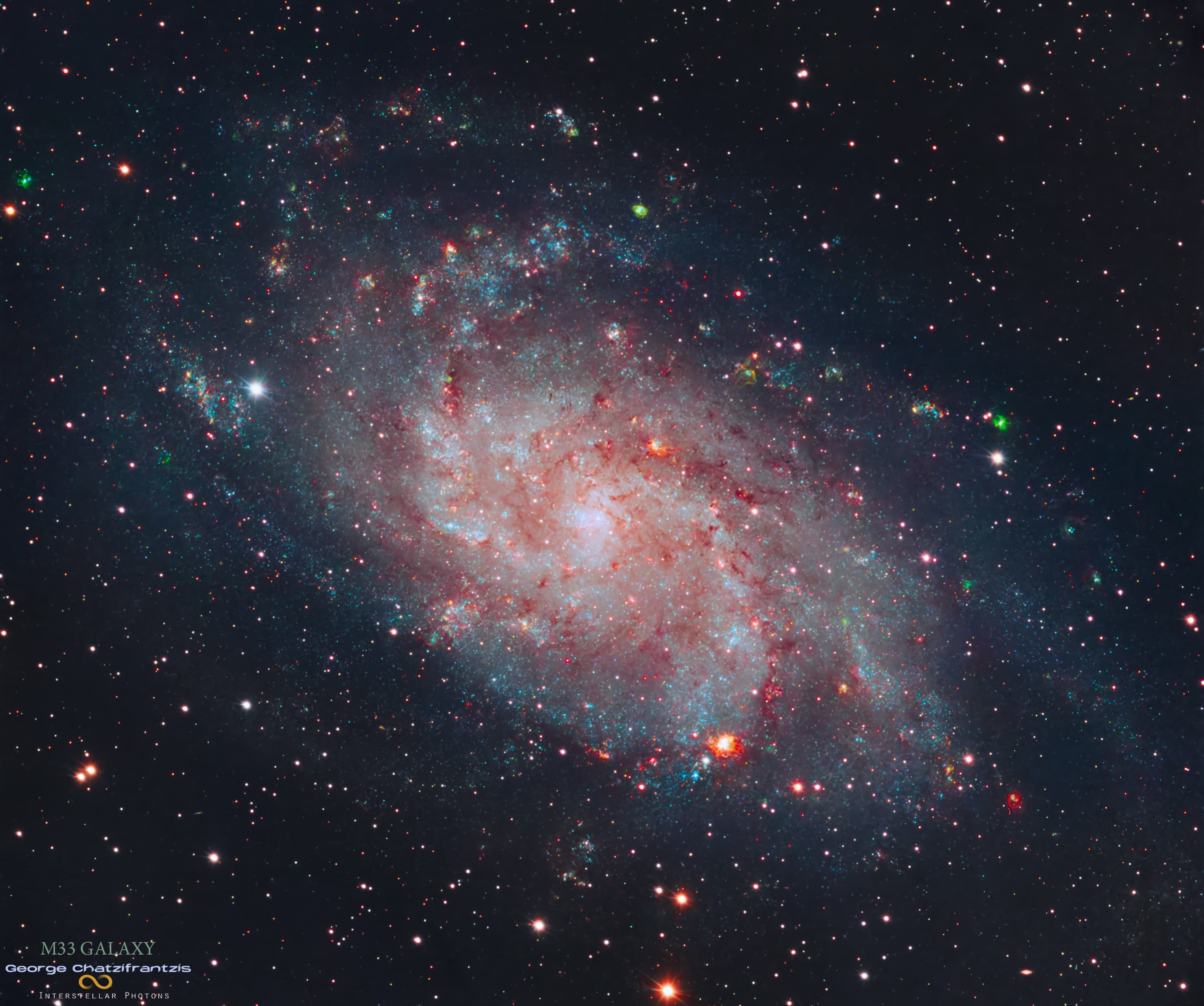
The small, northern constellation Triangulum harbors this magnificent face-on spiral galaxy, Messier 33. Its popular names include the Pinwheel Galaxy or just the Triangulum Galaxy. M33 is over 50,000 light-years in diameter, third largest in the Local Group of galaxies after the Andromeda Galaxy (M31), and our own Milky Way. About 3 million light-years from the Milky Way, M33 is itself thought to be a satellite of the Andromeda Galaxy and astronomers in these two galaxies would likely have spectacular views of each other's grand spiral star systems. As for the view from the Milky Way, this sharp telescopic image shows off M33's blue star clusters and pinkish star forming regions along the galaxy's loosely wound spiral arms. In fact, the cavernous NGC 604 is the brightest star forming region, seen here at about the 5 o'clock position from the galaxy center. Like M31, M33's population of well-measured variable stars have helped make this nearby spiral a cosmic yardstick for establishing the distance scale of the Universe. APOD's main NASA site is moving: From apod.nasa.gov to science.nasa.gov/apod
NeoWs Today
Closest approach
Miss distance
30,398,631 km
Velocity
55,618 km/h
Size est.
954 m
Hazard flag
No
260277 2004 TR12
Sep 18
79.05 LD
Clear
2016 RS
Sep 18
98.29 LD
Clear
2015 YA
Sep 18
110.17 LD
Clear
2016 FZ12
Sep 18
120.05 LD
Clear
2017 XD
Sep 18
124.85 LD
Clear
DONKI Space Weather
Flares
0
CMEs
18
Storms
0
CME
Sep 18 | NASA DONKI
CME
Sep 15 | NASA DONKI
CME
Sep 14 | NASA DONKI
CME
Sep 14 | S11W38
CME
Sep 13 | S10W10
CME
Sep 13 | S10W10
CME
Sep 13 | NASA DONKI
CME
Sep 13 | NASA DONKI
CME
Sep 13 | NASA DONKI
CME
Sep 12 | NASA DONKI
CME
Sep 12 | NASA DONKI
CME
Sep 11 | NASA DONKI
Mars Surface Feed
Sol
--
Earth date
Latest
Archive
--
Mars photos unavailable
The latest rover image feed did not return photos yet.
NASA News
Top headline
Published Fri, 18 Sep 2026 16:02:31 +0000.
Why it matters
Messier 33: The Triangulum Galaxy turns one sky object or mission view into a daily anchor for understanding distance, time, instruments, and light.
0 potentially hazardous classification does not mean impact risk; it means NASA is tracking size, orbit, and distance carefully.
Space weather can affect satellites, communications, navigation, and auroras, so quiet days and active days are both useful signals.
APOD story
Messier 33: The Triangulum Galaxy
Asteroid tracker
7 objects today
NASA archive
Search images, video, and audio
Ask COSMOS
Turn today's data into a guided explanation
NASA Mission Highlights
HQ | Jul 9
Artemis Program logo
HQ | Jul 9
Artemis logo-black
GSFC | Jan 3
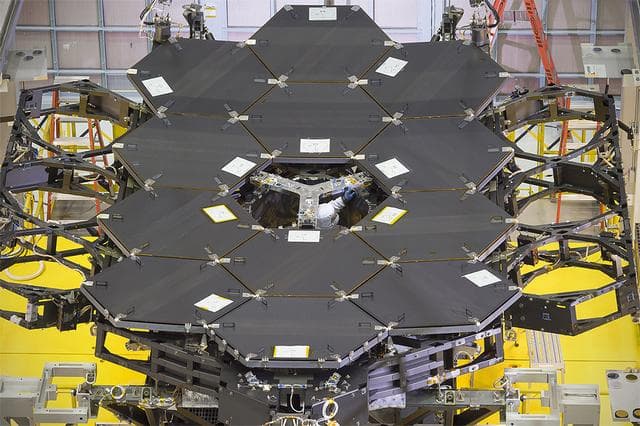
Caption: One dozen (out of 18) flight mirror segments that make up the primary mirror on NASA's James Webb Space Telescope have been installed at NASA's Goddard Space Flight Center. Credits: NASA/Chris Gunn More: Since December 2015, the team of scientists and engineers have been working tirelessly to install all the primary mirror segments onto the telescope structure in the large clean room at NASA's Goddard Space Flight Center in Greenbelt, Maryland. The twelfth mirror was installed on January 2, 2016. "This milestone signifies that all of the hexagonal shaped mirrors on the fixed central section of the telescope structure are installed and only the 3 mirrors on each wing are left for installation," said Lee Feinberg, NASA's Optical Telescope Element Manager at NASA Goddard. "The incredibly skilled and dedicated team assembling the telescope continues to find ways to do things faster and more efficiently." Each hexagonal-shaped segment measures just over 4.2 feet (1.3 meters) across and weighs approximately 88 pounds (40 kilograms). After being pieced together, the 18 primary mirror segments will work together as one large 21.3-foot (6.5-meter) mirror. The primary mirror will unfold and adjust to shape after launch. The mirrors are made of ultra-lightweight beryllium. The mirrors are placed on the telescope's backplane using a robotic arm, guided by engineers. The full installation is expected to be completed in a few months. The mirrors were built by Ball Aerospace & Technologies Corp., Boulder, Colorado. Ball is the principal subcontractor to Northrop Grumman for the optical technology and lightweight mirror system. The installation of the mirrors onto the telescope structure is performed by Harris Corporation of Rochester, New York. Harris Corporation leads integration and testing for the telescope. While the mirror assembly is a very significant milestone, there are many more steps involved in assembling the Webb telescope. The primary mirror and the tennis-court-sized sunshield are the largest and most visible components of the Webb telescope. However, there are four smaller components that are less visible, yet critical. The instruments that will fly aboard Webb - cameras and spectrographs with detectors able to record extremely faint signals — are part of the Integrated Science Instrument Module (ISIM), which is currently undergoing its final cryogenic vacuum test and will be integrated with the mirror later this year.
GSFC | Jan 3
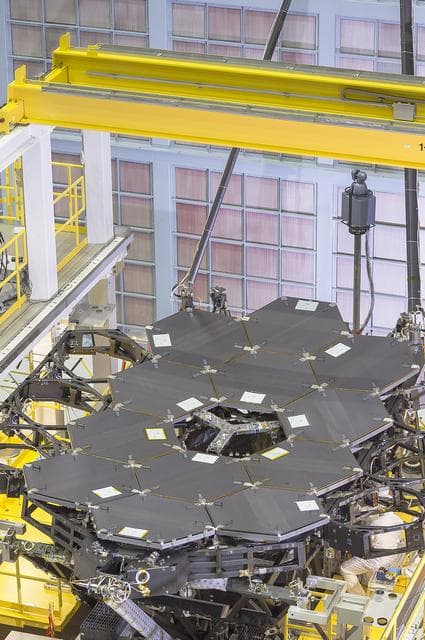
A view of the one dozen (out of 18) flight mirror segments that make up the primary mirror on NASA's James Webb Space Telescope have been installed at NASA's Goddard Space Flight Center. Credits: NASA/Chris Gunn More: Since December 2015, the team of scientists and engineers have been working tirelessly to install all the primary mirror segments onto the telescope structure in the large clean room at NASA's Goddard Space Flight Center in Greenbelt, Maryland. The twelfth mirror was installed on January 2, 2016. "This milestone signifies that all of the hexagonal shaped mirrors on the fixed central section of the telescope structure are installed and only the 3 mirrors on each wing are left for installation," said Lee Feinberg, NASA's Optical Telescope Element Manager at NASA Goddard. "The incredibly skilled and dedicated team assembling the telescope continues to find ways to do things faster and more efficiently." Each hexagonal-shaped segment measures just over 4.2 feet (1.3 meters) across and weighs approximately 88 pounds (40 kilograms). After being pieced together, the 18 primary mirror segments will work together as one large 21.3-foot (6.5-meter) mirror. The primary mirror will unfold and adjust to shape after launch. The mirrors are made of ultra-lightweight beryllium. The mirrors are placed on the telescope's backplane using a robotic arm, guided by engineers. The full installation is expected to be completed in a few months. The mirrors were built by Ball Aerospace & Technologies Corp., Boulder, Colorado. Ball is the principal subcontractor to Northrop Grumman for the optical technology and lightweight mirror system. The installation of the mirrors onto the telescope structure is performed by Harris Corporation of Rochester, New York. Harris Corporation leads integration and testing for the telescope. While the mirror assembly is a very significant milestone, there are many more steps involved in assembling the Webb telescope. The primary mirror and the tennis-court-sized sunshield are the largest and most visible components of the Webb telescope. However, there are four smaller components that are less visible, yet critical. The instruments that will fly aboard Webb - cameras and spectrographs with detectors able to record extremely faint signals — are part of the Integrated Science Instrument Module (ISIM), which is currently undergoing its final cryogenic vacuum test and will be integrated with the mirror later this year.
KSC | Apr 2
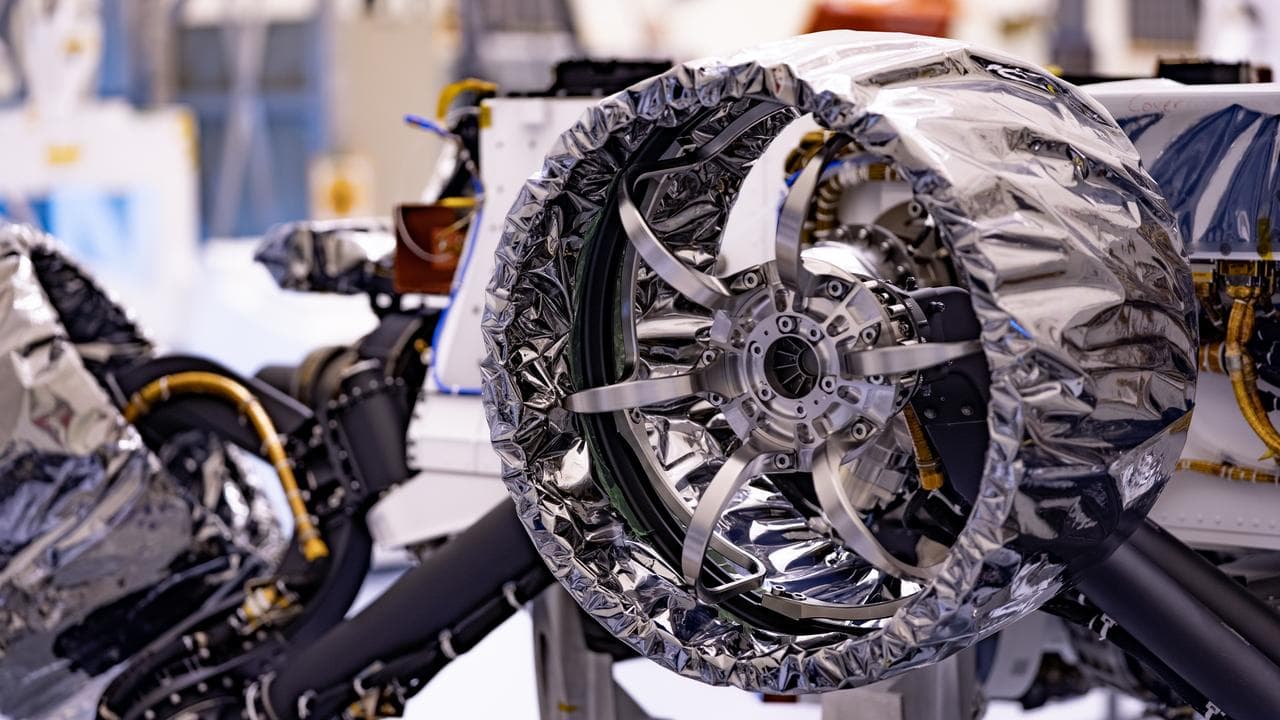
Wheels are installed on NASA’s Mars Perseverance rover inside Kennedy Space Center’s Payload Hazardous Servicing Facility on March 30, 2020. Perseverance will liftoff aboard a United Launch Alliance Atlas V 541 rocket from Cape Canaveral Air Force Station in July 2020. NASA’s Launch Services Program based at Kennedy is managing the launch. The rover will land on Mars on Feb. 18, 2021.
KSC | Apr 2
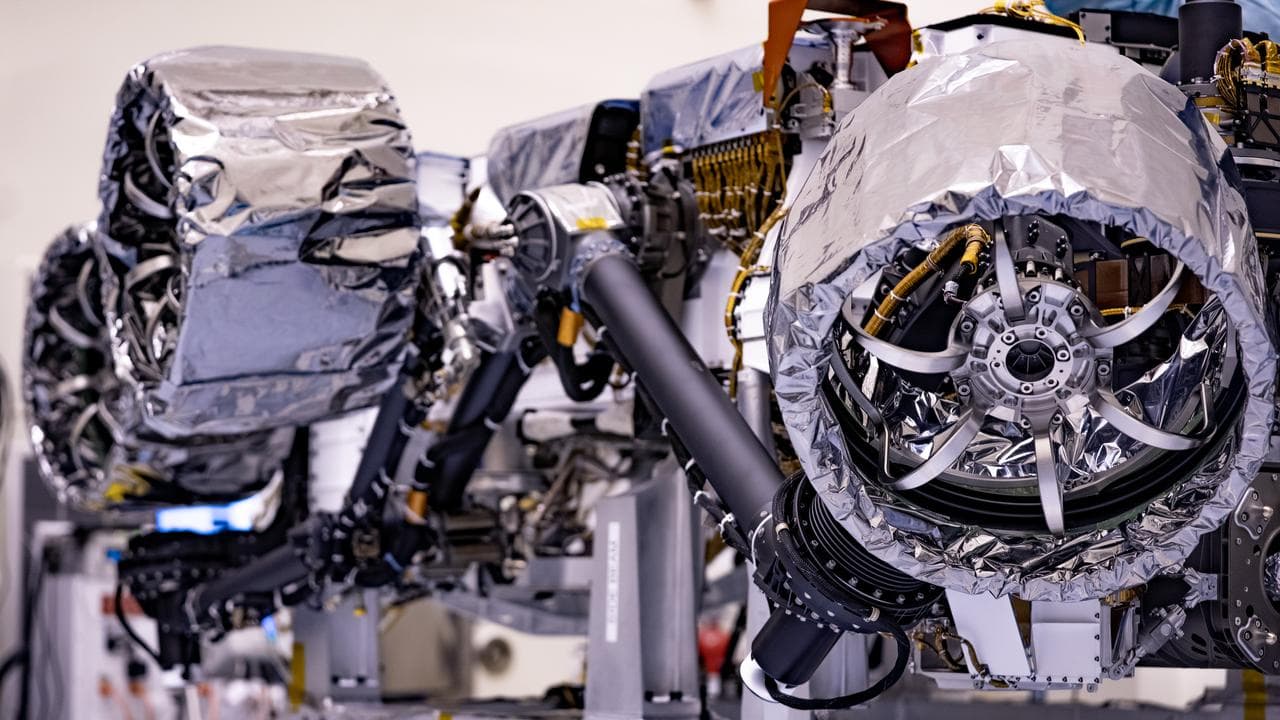
Wheels are installed on NASA’s Mars Perseverance rover inside Kennedy Space Center’s Payload Hazardous Servicing Facility on March 30, 2020. Perseverance will liftoff aboard a United Launch Alliance Atlas V 541 rocket from Cape Canaveral Air Force Station in July 2020. NASA’s Launch Services Program based at Kennedy is managing the launch. The rover will land on Mars on Feb. 18, 2021.